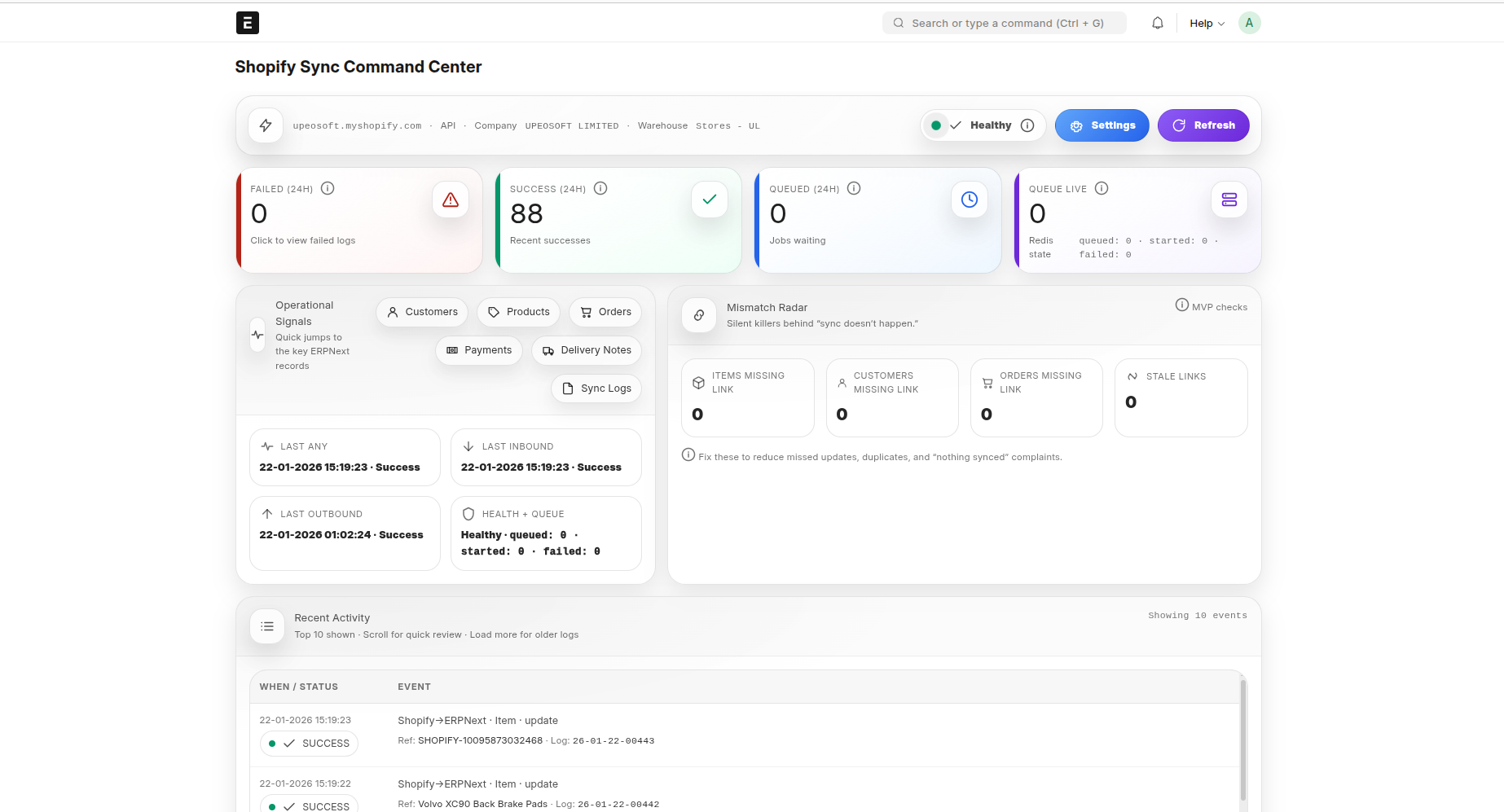
Integrating an ERP system with an eCommerce platform looks straightforward at first glance. Products sync. Orders flow in. Stock updates go out.
And for a while, everything seems fine.
Then, weeks or months later, issues start to appear:
- Prices revert unexpectedly
- Stock levels drift
- Orders look “wrong” in ERP
- Updates overwrite each other
- Background jobs fail silently
At this point, the problem is rarely a missing API call.
It’s almost always architecture.
This article documents the real engineering lessons that consistently surface when integrating ERPNext with Shopify in production environments – not demos, not tutorials, but systems running real businesses.
It is based on patterns observed repeatedly across implementations, and it explains why many integrations fail quietly and how mature integrations are designed differently.
The Core Problem: ERP and eCommerce Think Differently
Before diving into individual issues, it’s important to understand the root cause.
ERP systems and eCommerce platforms solve different problems:
- ERP systems prioritize accounting correctness, inventory valuation, and auditability
- eCommerce platforms prioritize speed, availability, and customer experience
An ERPNext–Shopify integration sits between two systems with different data models, lifecycles, and assumptions. Problems arise when these differences are ignored or simplified.
What follows are the eight most common engineering failure points – and the thinking required to avoid them.
1. Infinite Sync Loops (Echo Control)
One of the fastest ways to break an integration is to let it fight itself.
A typical failure pattern looks like this:
- Shopify updates a product
- A webhook updates ERPNext
- ERPNext saves the document
- An outbound hook pushes the update back to Shopify
- Shopify fires another webhook
- The cycle repeats indefinitely
This creates infinite sync loops, also known as echo loops.
The root cause is a lack of directional context.
A production-grade integration must always know:
- Whether it is processing inbound data (Shopify → ERPNext)
- Or performing an outbound sync (ERPNext → Shopify)
During inbound execution, outbound hooks must be suppressed. This is typically done using a scoped execution flag or sync context that outbound logic explicitly checks.
If inbound and outbound flows are not isolated, the integration will eventually destabilize itself.
2. Conflict Resolution: Who Wins?
Data conflicts are not edge cases. They are guaranteed.
A product price may be updated in ERPNext while a description is edited in Shopify. Both systems are correct — but the integration must choose.
If conflict resolution is not explicitly designed, overwrites occur based on:
- Webhook arrival order
- Queue execution timing
- Network latency
This leads to non-deterministic behavior, which users experience as “random bugs”.
Mature integrations define clear authority rules, commonly based on:
- Timestamps (e.g. last modified wins)
- System authority (ERPNext authoritative for financial fields, Shopify for content fields)
- Field-level ownership
The key principle is simple:
Conflict resolution must be deterministic, not accidental.
3. Idempotency and Webhook Retries
Shopify retries webhooks.
Queues retry jobs.
Networks fail.
This is normal.
An integration that assumes each event is unique will fail in production.
Idempotency means that processing the same event multiple times produces the same result. In practice, this requires:
- Never assuming “this record is new”
- Using stable external identifiers (such as Shopify IDs)
- Designing all writes as upserts, not blind creates
If replaying a webhook creates duplicate customers, items, or stock entries, the integration is not safe under real-world conditions.
Retry safety is not an enhancement.
It is a baseline requirement.
4. Partial Payload Reality
A subtle but destructive mistake is assuming Shopify webhooks always send complete objects.
They don’t.
Examples:
- Inventory webhooks do not include full product data
- Order update webhooks may omit customer blocks
- Variants can arrive independently of products
If an integration blindly overwrites ERPNext records using partial payloads, it will silently erase correct data.
The correct rule is:
Only update fields that are explicitly present in the payload.
This requires defensive merge logic rather than wholesale document updates. Integrations that ignore this rule often fail slowly – making the problem harder to detect and fix.
5. Inventory Is a Separate System
Inventory is not product data.
In Shopify:
- Products and variants define what can be sold
- Inventory levels define how much is available
- Inventory is tied to location IDs
In ERPNext:
- Inventory is managed through a stock ledger
- Movements, valuation, and reconciliation matter
- Delivery is not the same as reconciliation
Many integrations collapse these models into a single concept. This almost always leads to stock drift.
A correct integration:
- Maps Shopify locations to ERPNext warehouses
- Treats stock movements explicitly
- Separates inventory sync from product sync
Inventory errors destroy trust faster than almost anything else.
6. Status Mapping Is Not One-to-One
Shopify order statuses do not map directly to ERPNext document states.
Examples:
- “Paid” in Shopify does not mean an invoice is posted in ERPNext
- “Fulfilled” does not automatically imply delivery in ERP
- Refunds are not cancellations
ERP systems model financial and operational lifecycles, not just order state.
If statuses are mapped naively, the result is:
- Incorrect revenue reporting
- Broken stock flows
- Audit inconsistencies
Production-grade integrations define explicit mappings for:
- Financial status
- Fulfillment status
- ERP document lifecycle transitions
Semantic alignment matters more than visual status parity.
7. Permissions and Execution Context
A common mystery in failing integrations is:
“It works during the day, but fails at night.”
The reason is often execution context.
Webhooks and background workers do not run as logged-in users. They may execute as Guest or under restricted roles. If permissions are not explicitly handled, integrations fail unpredictably.
Reliable integrations:
- Use dedicated system or integration users
- Or deliberately bypass permissions in controlled scopes
- Apply permission logic consistently across inbound and outbound flows
Security matters – but predictability is essential.
8. Observability and Trust
Production integrations do not fail loudly. They fail silently.
When something goes wrong at 2AM, the most important question is:
Can you explain exactly what happened?
Observability means logging more than just errors. At a minimum, a trustworthy integration records:
- Sync direction (Shopify → ERPNext or vice versa)
- Entity and action
- Payload snapshot
- Error details
- Retry count
- Final linked ERPNext document
Visibility is not just for developers. It is how operators and businesses build confidence in the system.
An integration that cannot be explained cannot be trusted.
Demo and Video Series
To complement this article:
- 🎥 1 full demo video shows the ERPNext-Shopify integration in action
- 🧠 8 engineering lesson videos break down each of the topics above in detail
Final Thoughts
Most ERP-eCommerce integrations fail not because of missing features, but because of missing engineering discipline.
Production systems demand:
- Deterministic behavior
- Defensive data handling
- Clear authority rules
- Visibility when things go wrong
When these principles are respected, ERPNext and Shopify can work together reliably – not just in demos, but in the real world.
